HTGL74 CubixR-a
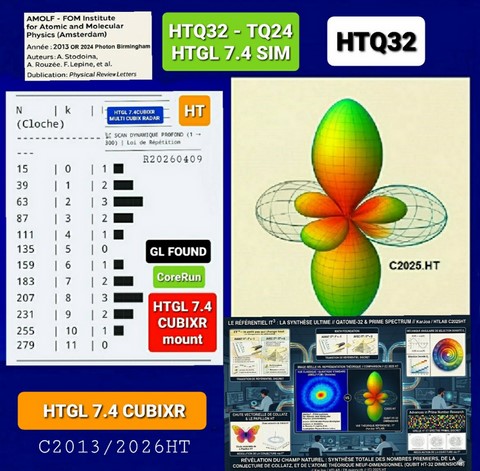
# HTGL7.4-CubixR
# BASE STABLE DE RECHERCHE
# C2013/2026 HTKARJOA
# Geometric Logic - Cloche_shadow
# HTQ32GL / TQ24 / Cube / RADAR /
# Papillon / Factorizer / CubixR

PYTHON
- # ============================================================
# V20260410HTKARJOA
# HTGL7.4-CubixR
# BASE STABLE DE RECHERCHE
# C2013/2026 HTKARJOA
# Geometric Logic - Cloche_shadow
# HTQ32GL / TQ24 / Cube / RADAR /
# Papillon / Factorizer / CubixR
# ============================================================
import math
from dataclasses import dataclass
from typing import List, Dict, Optional, Tuple
# ============================================================
# DATA CLASSES
# ============================================================
@dataclass
class HTQ32GLVector:
index: int
angle: float
density: float
rotation: int
phase: complex
@dataclass
class TQ24Vector:
index: int
angle: float
density: int
rotation: int
charge: int = 0
@dataclass
class TQ24State:
input_value: int
vectors: List[TQ24Vector]
density_distribution: Dict[int, int]
rotation_distribution: Dict[int, int]
carry_history: List[int]
@dataclass
class PapillonReading:
high_density_nodes: List[int]
pelote_signatures: List[dict]
extracted_signature: str
candidate_factors: List[int]
scores: Dict[int, float]
note: str
t_level: str
clusters_count: int
@dataclass
class FactorResult:
N: int
factors: List[Tuple[int, int]]
candidates_used: List[int]
papillon_signature: str
note: str
validation_mode: str
@dataclass
class RadarState:
z_ratio: float
deep_energy: float
max_z: float
is_critical: bool
@dataclass
class CubixRResult:
cubes_processed: int
propagation_log: List[int]
stopped_on_cube: int
final_critical_state: bool
# ============================================================
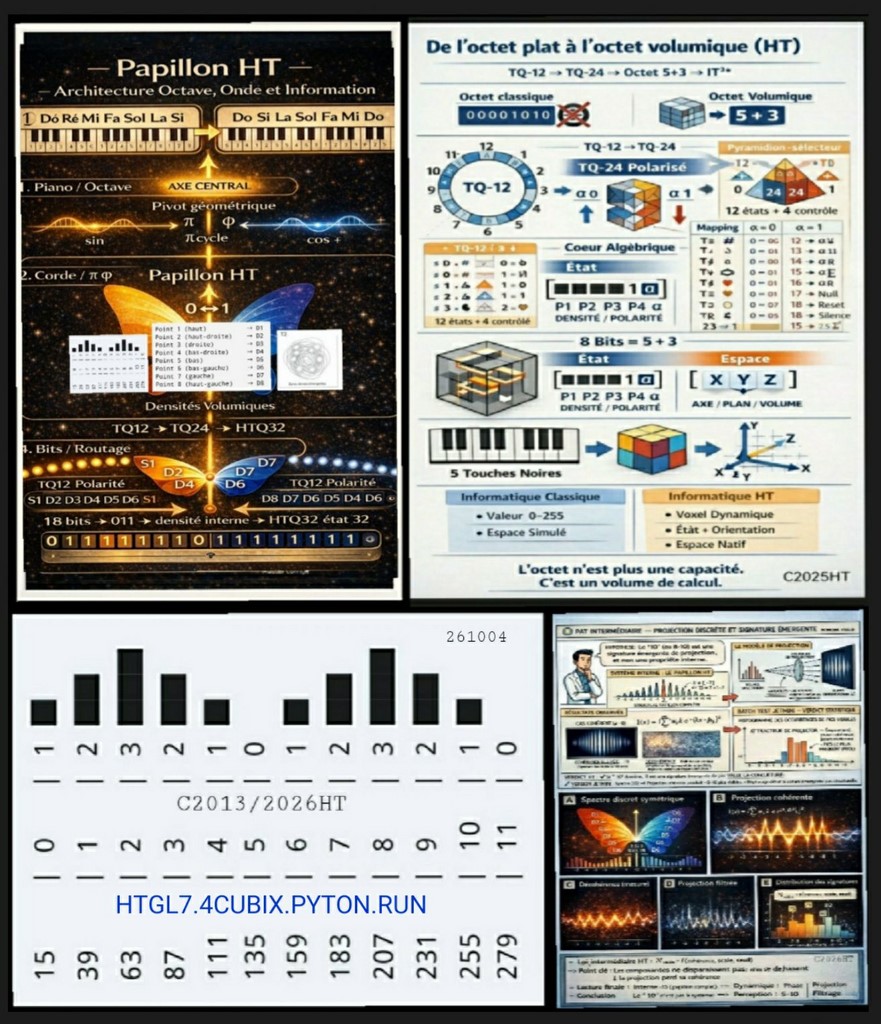
# OCTAVE SONORE
# ============================================================
class PianoOctaveMapping:
def __init__(self):
self.note_to_tq12_base = {
"C": 0,
"C#": 1,
"D": 2,
"D#": 3,
"E": 4,
"F": 5,
"F#": 6,
"G": 7,
"G#": 8,
"A": 9,
"A#": 10,
"B": 11,
}
def note_to_tq12(self, note_name: str) -> Optional[int]:
if not note_name or len(note_name) < 2:
return None
return self.note_to_tq12_base.get(note_name[:-1].upper())
def get_tq12_indices(self, notes: List[str]) -> List[int]:
out = []
for note in notes:
idx = self.note_to_tq12(note)
if idx is not None:
out.append(idx)
return out
# ============================================================
# OCTAVE LUMINEUSE
# ============================================================
class LightOctaveMapping:
def __init__(self):
self.wavelength_to_phase = {
"red": 0,
"orange": 30,
"yellow": 60,
"green": 120,
"cyan": 180,
"blue": 240,
"violet": 300,
}
self.cesium_clock = 133
def color_phase(self, light_color: str) -> float:
return math.radians(self.wavelength_to_phase.get(light_color.lower(), 240))
def apply_luminous_ripage(
self,
vectors: List[HTQ32GLVector],
N: int,
light_color: str = "blue"
) -> List[HTQ32GLVector]:
cesium_factor = math.cos(math.radians(self.cesium_clock * (N % 360)))
phase_shift = self.color_phase(light_color)
for v in vectors:
v.angle = (
v.angle + phase_shift + cesium_factor * (math.pi / 2.0)
) % (2.0 * math.pi)
v.phase = complex(math.cos(v.angle), math.sin(v.angle))
v.density *= (1.0 + 0.30 * abs(cesium_factor))
return vectors
# ============================================================
# HTQ32GL_LABO
# ============================================================
class HTQ32GL_Labo:
def __init__(self):
self.base_angles = [math.radians(11.25 * i) for i in range(32)]
def encode(
self,
N: int,
musical_tq12: Optional[List[int]] = None
) -> List[HTQ32GLVector]:
vectors: List[HTQ32GLVector] = []
base_angle = math.radians(N % 360)
musical_set = set(musical_tq12 or [])
for i in range(32):
angle = (base_angle + self.base_angles[i]) % (2.0 * math.pi)
density = 1.0 + ((N + i) % 8)
if (i % 12) in musical_set:
density += 1.0
rotation = (i % 4) + 1
phase = complex(math.cos(angle), math.sin(angle))
vectors.append(HTQ32GLVector(i, angle, density, rotation, phase))
return vectors
def project_to_tq12(self, vectors: List[HTQ32GLVector], N: int) -> List[float]:
charges = [0.0] * 12
dynamic_shift = int(round((N % 12) * 0.5))
for v in vectors:
target = (v.index + dynamic_shift) % 12
charges[target] += v.density
max_charge = max(charges) if charges else 1.0
if max_charge <= 0:
return charges
return [(c / max_charge) * 8.0 for c in charges]
# ============================================================
# TQ24
# ============================================================
class TQ24:
def __init__(self):
self.tq12_angles = [math.radians(30 * i) for i in range(12)]
def vector(self, i: int) -> TQ24Vector:
return TQ24Vector(
index=i % 24,
angle=self.tq12_angles[i % 12],
density=(i % 8) + 1,
rotation=(i % 4) + 1,
charge=0
)
def push(self, vector: TQ24Vector, charge_delta: int) -> TQ24Vector:
vector.charge += charge_delta
new_density = vector.density + vector.charge
carry = 0
while new_density > 8:
new_density -= 8
carry += 1
if carry > 0:
vector.angle = (vector.angle + math.pi) % (2.0 * math.pi)
vector.charge = 0
vector.density = new_density if new_density > 0 else 8
vector.rotation = ((vector.rotation - 1 + carry) % 4) + 1
return vector
def dist_density(self, vs: List[TQ24Vector]) -> Dict[int, int]:
d = {i: 0 for i in range(1, 9)}
for v in vs:
d[v.density] += 1
return d
def dist_rotation(self, vs: List[TQ24Vector]) -> Dict[int, int]:
d = {i: 0 for i in range(1, 5)}
for v in vs:
d[v.rotation] += 1
return d
def state(self, N: int, injected_charges: Optional[List[float]] = None) -> TQ24State:
vectors = [self.vector(i) for i in range(24)]
if injected_charges is None:
htq = HTQ32GL_Labo()
injected_charges = htq.project_to_tq12(htq.encode(N), N)
carry_log: List[int] = []
for i, v in enumerate(vectors):
charge_to_push = int(round(injected_charges[i % 12]))
pushed = self.push(v, charge_to_push)
if pushed.charge == 0 and charge_to_push > 0:
carry_log.append(pushed.index)
return TQ24State(
input_value=N,
vectors=vectors,
density_distribution=self.dist_density(vectors),
rotation_distribution=self.dist_rotation(vectors),
carry_history=carry_log,
)
# ============================================================
# VOLUMETRIC HT CUBE
# ============================================================
class VolumetricHTCube:
def __init__(self):
self.size = (12, 8, 4)
def create_empty_cube(self) -> List[List[List[float]]]:
return [
[[0.0 for _ in range(self.size[2])] for _ in range(self.size[1])]
for _ in range(self.size[0])
]
def project_to_cube(
self,
state: TQ24State,
N: int,
light_color: str = "blue"
) -> List[List[List[float]]]:
cube = self.create_empty_cube()
light = LightOctaveMapping()
cesium_factor = math.cos(math.radians(light.cesium_clock * (N % 360)))
color_phase = light.color_phase(light_color)
base_angle = math.pi * (N / 12.0)
raw_values = []
for v in state.vectors:
x = v.index % 12
y = v.density - 1
z = v.rotation - 1
phase_term = math.cos(base_angle + color_phase + z * (math.pi / 2.0))
phase_term = max(0.0, phase_term)
value = v.density * (1.0 + 0.22 * abs(cesium_factor)) * phase_term
cube[x][y][z] += value
raw_values.append(value)
non_zero = [v for v in raw_values if v > 0]
mean_non_zero = sum(non_zero) / len(non_zero) if non_zero else 0.0
threshold = max(1.6, mean_non_zero * 0.72)
for x in range(12):
for y in range(8):
for z in range(4):
if cube[x][y][z] < threshold:
cube[x][y][z] = 0.0
return cube
def get_dense_clusters(self, cube: List[List[List[float]]]) -> List[dict]:
non_zero = []
for x in range(12):
for y in range(8):
for z in range(4):
if cube[x][y][z] > 0:
non_zero.append(cube[x][y][z])
if not non_zero:
return []
mean_non_zero = sum(non_zero) / len(non_zero)
cluster_threshold = max(2.0, mean_non_zero * 0.92)
clusters = []
for x in range(12):
for y in range(8):
for z in range(4):
value = cube[x][y][z]
if value >= cluster_threshold:
clusters.append({
"x": x,
"y": y + 1,
"z": z + 1,
"value": round(value, 4)
})
return clusters
# ============================================================
# RADAR DETECTOR
# ============================================================
class RadarDetector:
def detect(self, cube: List[List[List[float]]]) -> RadarState:
total = 0.0
deep_energy = 0.0
max_z = 0.0
size_x = len(cube)
size_y = len(cube[0]) if size_x > 0 else 0
size_z = len(cube[0][0]) if size_y > 0 else 0
for x in range(size_x):
for y in range(size_y):
for z in range(size_z):
v = cube[x][y][z]
total += v
if z >= 2:
deep_energy += v
if v > max_z:
max_z = v
if total == 0:
return RadarState(0.0, 0.0, 0.0, False)
mean_energy = total / (size_x * size_y * size_z)
z_ratio = deep_energy / total
is_critical = (
z_ratio > 0.15 and
deep_energy > mean_energy and
max_z > 2.0
)
return RadarState(
z_ratio=round(z_ratio, 6),
deep_energy=round(deep_energy, 6),
max_z=round(max_z, 6),
is_critical=is_critical
)
# ============================================================
# PAPILLON GEOMETRIC
# ============================================================
class PapillonGeometric:
def __init__(self):
self.primes_test = [3, 5, 7, 11, 13, 17, 19, 23, 29, 31]
def _cluster_continuity(self, clusters: List[dict], target_x: int) -> float:
if not clusters:
return 0.0
xs = sorted(c["x"] for c in clusters)
continuity = 0.0
for x in xs:
dx = min((x - target_x) % 12, (target_x - x) % 12)
continuity += max(0.0, 1.0 - dx / 3.0)
return continuity / len(xs)
def read(self, state: TQ24State, cube: List[List[List[float]]]) -> PapillonReading:
cube_obj = VolumetricHTCube()
clusters = cube_obj.get_dense_clusters(cube)
if not clusters:
return PapillonReading(
high_density_nodes=[],
pelote_signatures=[],
extracted_signature="NO_CLUSTERS",
candidate_factors=[],
scores={},
note="Aucun cluster voxel détecté",
t_level="T1",
clusters_count=0
)
high_nodes = [c["x"] for c in clusters]
pelotes = [{
"index": c["x"],
"density": c["y"],
"rotation": c["z"],
"value": c["value"]
} for c in clusters]
central_density_clusters = [c for c in clusters if 3 <= c["y"] <= 5]
upper_rotation_clusters = [c for c in clusters if c["z"] >= 3]
sig = (
f"L{len(set(high_nodes))}"
f"C{len(central_density_clusters)}"
f"R{len(upper_rotation_clusters)}"
f"_T{len(clusters)}"
)
total_value = sum(c["value"] for c in clusters) or 1.0
strong_cut = max(c["value"] for c in clusters) * 0.70
scores: Dict[int, float] = {}
for p in self.primes_test:
target_density = p % 8 if p % 8 != 0 else 8
target_x = p % 12
density_mass = 0.0
x_mass = 0.0
z_mass = 0.0
strong_bonus = 0.0
for c in clusters:
if c["y"] == target_density:
density_mass += 1.65 * c["value"]
dx = min((c["x"] - target_x) % 12, (target_x - c["x"]) % 12)
x_weight = max(0.0, 1.0 - (dx / 5.0))
x_mass += 0.75 * x_weight * c["value"]
if c["z"] in (2, 3):
z_mass += 0.32 * c["value"]
elif c["z"] == 4:
z_mass += 0.15 * c["value"]
if c["value"] >= strong_cut and c["y"] == target_density and dx <= 1:
strong_bonus += 0.40 * c["value"]
continuity = self._cluster_continuity(clusters, target_x)
score = (density_mass + x_mass + z_mass + strong_bonus) / total_value
score *= (0.70 + 0.30 * continuity)
if p >= 23 and strong_bonus == 0.0:
score *= 0.82
scores[p] = round(score, 4)
candidates = [p for p, s in scores.items() if s >= 0.90]
candidates = sorted(candidates, key=lambda p: scores[p], reverse=True)[:6]
if state.input_value % 12 > 6:
t_level = "T4"
elif len(candidates) >= 2:
t_level = "T2"
else:
t_level = "T1"
return PapillonReading(
high_density_nodes=high_nodes,
pelote_signatures=pelotes,
extracted_signature=sig,
candidate_factors=candidates,
scores=scores,
note="PapillonGeometric HTGL7.4-CubixR — score cohérence clusters",
t_level=t_level,
clusters_count=len(clusters)
)
# ============================================================
# FACTORIZER
# ============================================================
class HTFactorizer:
def factorize(
self,
N: int,
reading: PapillonReading,
validation_mode: str = "pure"
) -> FactorResult:
candidates = sorted(set(reading.candidate_factors))
valid_pairs: List[Tuple[int, int]] = []
if validation_mode not in {"pure", "hybrid"}:
raise ValueError("validation_mode must be 'pure' or 'hybrid'")
if validation_mode == "pure":
note = "Validation géométrique seule"
for i in range(len(candidates)):
for j in range(i, len(candidates)):
a = candidates[i]
b = candidates[j]
if a * b == N and b >= a:
valid_pairs.append((a, b))
if not valid_pairs:
note = "Aucune paire purement géométrique trouvée"
else:
note = "Validation hybride (candidats géométriques + divisibilité minimale)"
for a in candidates:
if a > 1 and N % a == 0:
b = N // a
if b >= a:
valid_pairs.append((a, b))
for i in range(len(candidates)):
for j in range(i, len(candidates)):
a, b = sorted((candidates[i], candidates[j]))
if a * b == N:
valid_pairs.append((a, b))
valid_pairs = sorted(set(valid_pairs))
return FactorResult(
N=N,
factors=valid_pairs,
candidates_used=candidates,
papillon_signature=reading.extracted_signature,
note=note,
validation_mode=validation_mode,
)
# ============================================================
# CUBIXR MULTI-CUBES
# ============================================================
class CubixRChain:
def __init__(self, num_cubes: int = 4):
self.num_cubes = num_cubes
self.cubes: List[List[List[List[float]]]] = []
self.propagation_log: List[int] = []
def _boost_state(self, state: TQ24State) -> TQ24State:
boosted_vectors: List[TQ24Vector] = []
for v in state.vectors:
boosted_vectors.append(
TQ24Vector(
index=v.index,
angle=v.angle,
density=min(8, v.density + 1),
rotation=v.rotation,
charge=0
)
)
density_distribution = {i: 0 for i in range(1, 9)}
rotation_distribution = {i: 0 for i in range(1, 5)}
for v in boosted_vectors:
density_distribution[v.density] += 1
rotation_distribution[v.rotation] += 1
return TQ24State(
input_value=state.input_value,
vectors=boosted_vectors,
density_distribution=density_distribution,
rotation_distribution=rotation_distribution,
carry_history=list(state.carry_history)
)
def run(
self,
initial_state: TQ24State,
N: int,
light_color: str = "blue",
verbose: bool = True
) -> CubixRResult:
cube_obj = VolumetricHTCube()
radar = RadarDetector()
current_state = initial_state
last_critical = False
stopped_on_cube = 0
for cube_index in range(self.num_cubes):
cube = cube_obj.project_to_cube(current_state, N, light_color=light_color)
self.cubes.append(cube)
radar_state = radar.detect(cube)
last_critical = radar_state.is_critical
stopped_on_cube = cube_index
if verbose:
print(
f"[CubixR Cube {cube_index}] "
f"CRIT={radar_state.is_critical} "
f"| z_ratio={round(radar_state.z_ratio,4)} "
f"| deep={round(radar_state.deep_energy,4)} "
f"| max_z={round(radar_state.max_z,4)}"
)
if radar_state.is_critical:
self.propagation_log.append(cube_index)
current_state = self._boost_state(current_state)
else:
break
return CubixRResult(
cubes_processed=len(self.cubes),
propagation_log=self.propagation_log,
stopped_on_cube=stopped_on_cube,
final_critical_state=last_critical
)
# ============================================================
# STATS
# ============================================================
def cube_stats(cube: List[List[List[float]]]) -> Dict[str, float]:
non_zero = []
total = 0.0
for plane in cube:
for row in plane:
for value in row:
total += value
if value > 0:
non_zero.append(value)
return {
"volume_total": round(total, 4),
"voxels_non_nuls": len(non_zero),
"max_voxel": round(max(non_zero), 4) if non_zero else 0.0,
"mean_non_zero": round(sum(non_zero) / len(non_zero), 4) if non_zero else 0.0,
}
# ============================================================
# PIPELINE COMPLET
# ============================================================
def htgl_cubixr(
N: int,
notes: List[str],
light_color: str = "blue",
validation_mode: str = "pure",
enable_cubixr: bool = True,
num_cubes: int = 4
) -> Dict[str, object]:
piano = PianoOctaveMapping()
light = LightOctaveMapping()
htq = HTQ32GL_Labo()
core = TQ24()
cube_obj = VolumetricHTCube()
radar = RadarDetector()
papillon = PapillonGeometric()
factorizer = HTFactorizer()
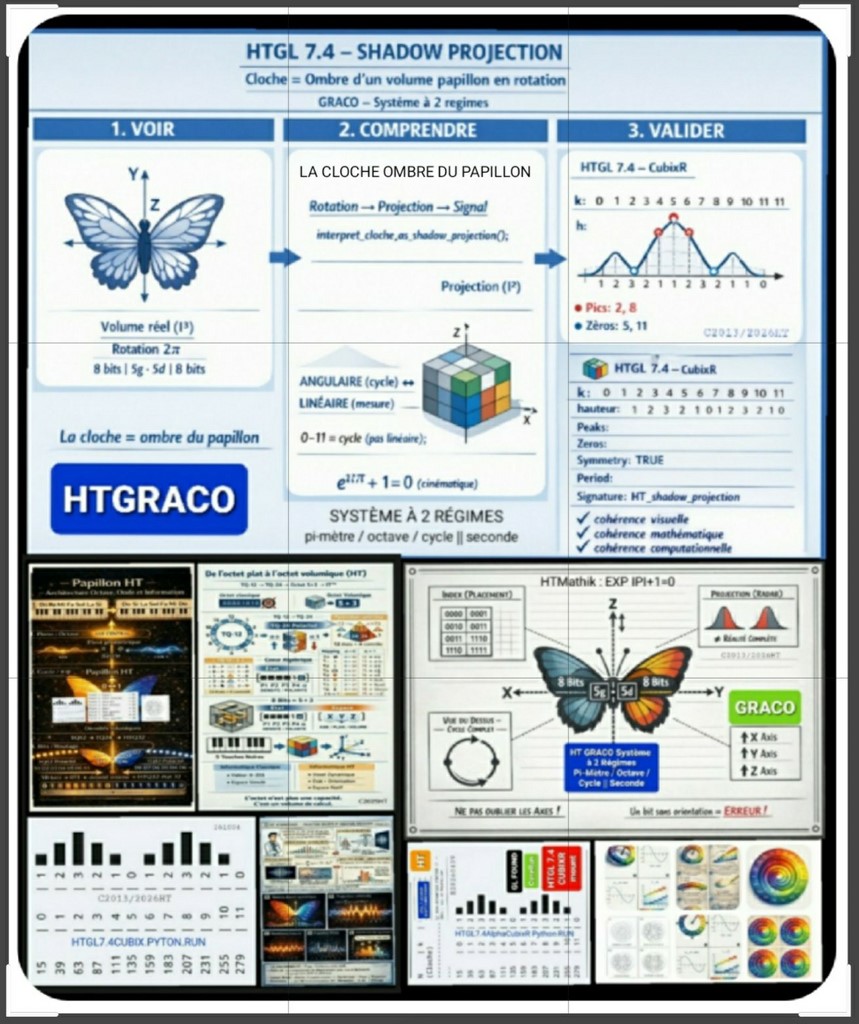
def interpret_cloche_as_shadow_projection(height_list, k_list):
"""
Interprétation HT :
La cloche est une projection d’ombre d’un volume en rotation (papillon).
"""
n = len(height_list)
# --- Détection max / min ---
max_val = max(height_list)
min_val = min(height_list)
peaks = [k_list[i] for i, h in enumerate(height_list) if h == max_val]
zeros = [k_list[i] for i, h in enumerate(height_list) if h == min_val]
# --- Symétrie ---
symmetric = True
for i in range(n // 2):
if height_list[i] != height_list[i + n // 2]:
symmetric = False
break
# --- Périodicité ---
period = None
for p in range(1, n):
if height_list[:p] == height_list[p:2*p]:
period = p
break
# --- Interprétation ---
interpretation = {
"type": "HT_shadow_projection",
"max_relief": max_val,
"peaks_k": peaks,
"zero_projection_k": zeros,
"symmetry": symmetric,
"period": period,
"message": (
"Cloche = projection d’ombre d’un volume papillon en rotation (cycle 2π). "
"Les maxima correspondent au relief maximal projeté. "
"Les zéros correspondent à l’alignement minimal (pivot géométrique)."
)
}
return interpretation
tq12_indices = piano.get_tq12_indices(notes)
vectors = htq.encode(N, tq12_indices)
vectors = light.apply_luminous_ripage(vectors, N, light_color=light_color)
charges = htq.project_to_tq12(vectors, N)
state = core.state(N, injected_charges=charges)
cube = cube_obj.project_to_cube(state, N, light_color=light_color)
radar_state = radar.detect(cube)
reading = papillon.read(state, cube)
factor_result = factorizer.factorize(N, reading, validation_mode=validation_mode)
stats = cube_stats(cube)
cubixr_result = None
if enable_cubixr and radar_state.is_critical:
chain = CubixRChain(num_cubes=num_cubes)
cubixr_result = chain.run(state, N, light_color=light_color, verbose=True)
print("\n" + "═" * 110)
print(
f"HTGL7.4-CubixR | N={N} | light={light_color.upper()} "
f"| notes={notes} | mode={validation_mode}"
)
print("═" * 110)
print(f"[Encode] HTQ32 vectors = {len(vectors)} | piano indices = {tq12_indices}")
print(f"[TQ24] carry_history = {state.carry_history}")
print(
f"[Cube] volume = {stats['volume_total']} "
f"| voxels_non_nuls = {stats['voxels_non_nuls']} "
f"| max = {stats['max_voxel']}"
)
print(
f"[RADAR] z_ratio = {round(radar_state.z_ratio,4)} "
f"| deep = {round(radar_state.deep_energy,4)} "
f"| max_z = {round(radar_state.max_z,4)} "
f"| CRIT = {radar_state.is_critical}"
)
print(
f"[Papillon] signature = {reading.extracted_signature} "
f"| T-Level = {reading.t_level} "
f"| clusters = {reading.clusters_count}"
)
print(f"[Papillon] candidats = {reading.candidate_factors}")
print(f"[Papillon] scores = {reading.scores}")
print(f"[Factorizer] facteurs = {factor_result.factors if factor_result.factors else '—'}")
print(f"[Note] {factor_result.note}")
if cubixr_result is not None:
print(
f"[CubixR] cubes_processed = {cubixr_result.cubes_processed} "
f"| propagation_log = {cubixr_result.propagation_log} "
f"| stopped_on_cube = {cubixr_result.stopped_on_cube}"
)
else:
print("[CubixR] —")
print("═" * 110)
return {
"state": state,
"cube": cube,
"radar": radar_state,
"papillon": reading,
"factorizer": factor_result,
"cubixr": cubixr_result,
"stats": stats,
}
# ============================================================
# TESTS STABILITÉ
# ============================================================
def run_stability_tests_cubixr(validation_mode: str = "pure"):
tests = [
(15, ["C4", "E4"], "blue"),
(21, ["D4", "F4"], "blue"),
(35, ["F4", "A4"], "blue"),
(39, ["C4", "G4"], "blue"),
(63, ["E4", "G4"], "blue"),
(77, ["A3", "C4", "E4"], "blue"),
(85, ["F4", "A4", "C5"], "orange"),
(87, ["A4", "C5"], "blue"),
(143, ["C3", "G3"], "violet"),
]
print(f"=== TESTS DE STABILITÉ HTGL7.4-CubixR | mode={validation_mode} ===")
results = []
for N, notes, color in tests:
result = htgl_cubixr(
N=N,
notes=notes,
light_color=color,
validation_mode=validation_mode,
enable_cubixr=True,
num_cubes=4
)
factors = result["factorizer"].factors
candidates = result["factorizer"].candidates_used
crit = result["radar"].is_critical
cubixr_log = result["cubixr"].propagation_log if result["cubixr"] is not None else []
results.append((N, factors, candidates, crit, cubixr_log))
print("\n=== RÉCAPITULATIF ===")
for N, factors, candidates, crit, cubixr_log in results:
print(
f"N={N:<4} | CRIT={str(crit):<5} | facteurs={str(factors):<20} "
f"| candidats={str(candidates):<24} | CubixR={cubixr_log}"
)
# ============================================================
# RADAR SCAN
# ============================================================
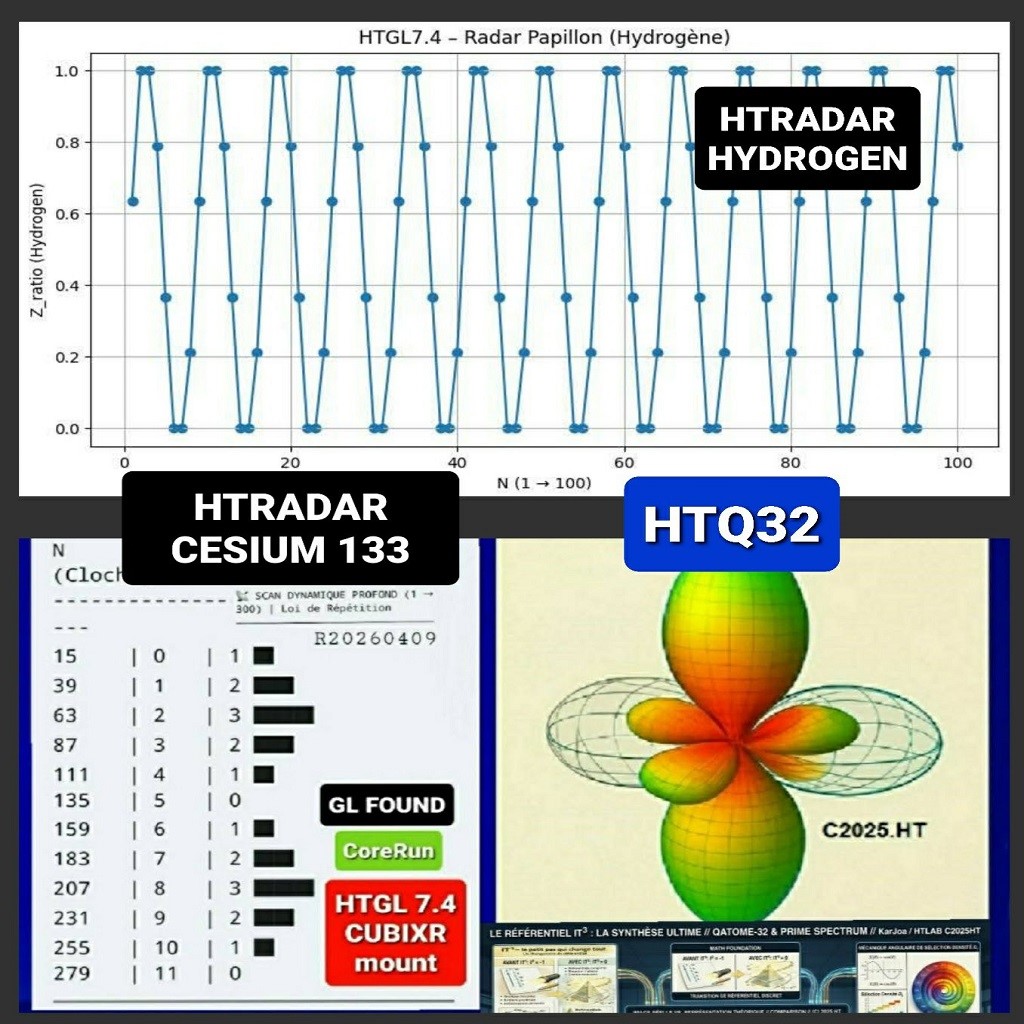
def radar_scan_1_to_100(notes: List[str] = None, light_color: str = "blue"):
if notes is None:
notes = ["C4", "E4"]
print("\n" + "═" * 110)
print("📡 RADAR SCAN 1 → 100 | HTGL7.4-CubixR")
print("═" * 110)
critical_values = []
for N in range(1, 101):
piano = PianoOctaveMapping()
light = LightOctaveMapping()
htq = HTQ32GL_Labo()
core = TQ24()
cube_obj = VolumetricHTCube()
radar = RadarDetector()
tq12_indices = piano.get_tq12_indices(notes)
vectors = htq.encode(N, tq12_indices)
vectors = light.apply_luminous_ripage(vectors, N, light_color=light_color)
charges = htq.project_to_tq12(vectors, N)
state = core.state(N, injected_charges=charges)
cube = cube_obj.project_to_cube(state, N, light_color=light_color)
radar_state = radar.detect(cube)
if radar_state.is_critical:
critical_values.append(N)
print(
f"N={N:<3} | z_ratio={radar_state.z_ratio:<8} "
f"| deep={radar_state.deep_energy:<10} "
f"| max_z={radar_state.max_z:<8}"
)
print("═" * 110)
print(f"Famille Z activée : {critical_values}")
print("═" * 110)
# ============================================================
# MAIN
# ============================================================
if __name__ == "__main__":
run_stability_tests_cubixr("pure")
# Décommente si besoin :
# run_stability_tests_cubixr("hybrid")
# radar_scan_1_to_100(["C4", "E4"], "blue"
# Décommente si besoin :
# result = interpret_cloche_as_shadow_projection(heights, k_values)
# print("=== HT INTERPRETATION ===")
# print(result["message"])
# print("Peaks:", result["peaks_k"])
# print("Zeros:", result["zero_projection_k"])
-

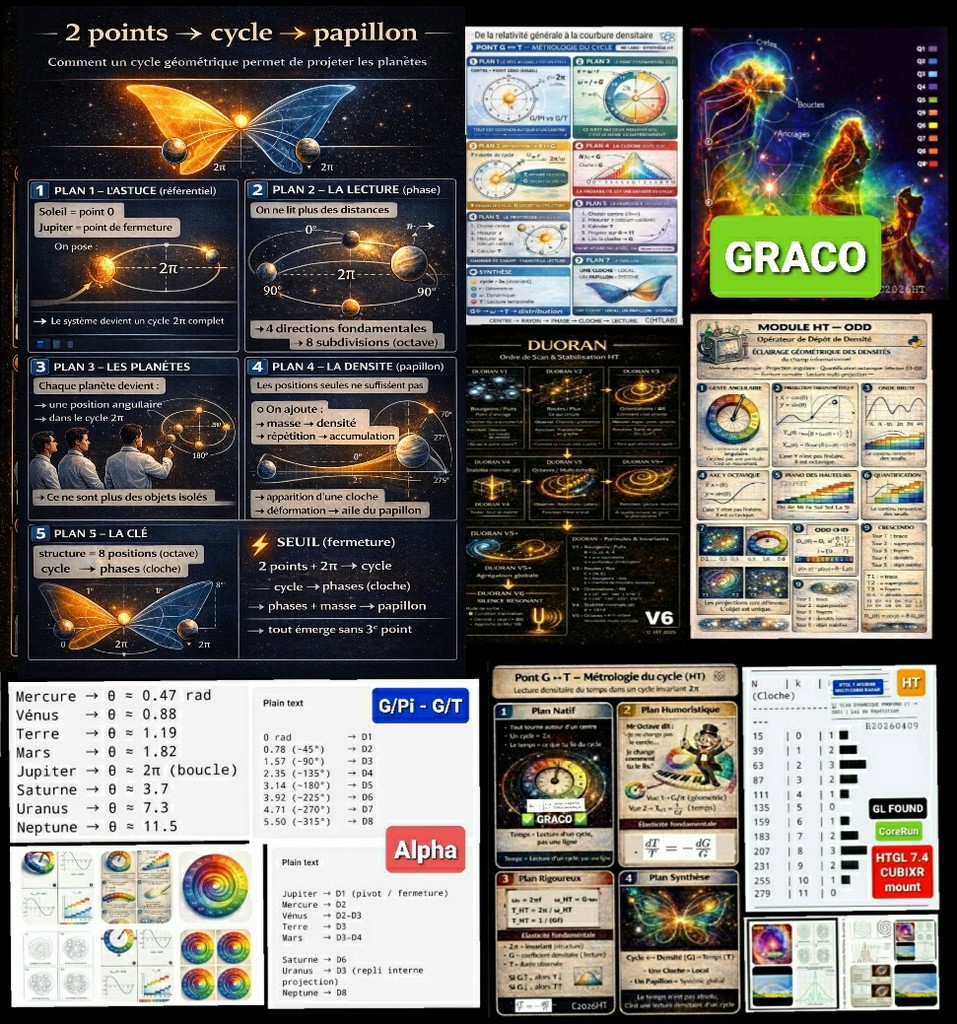
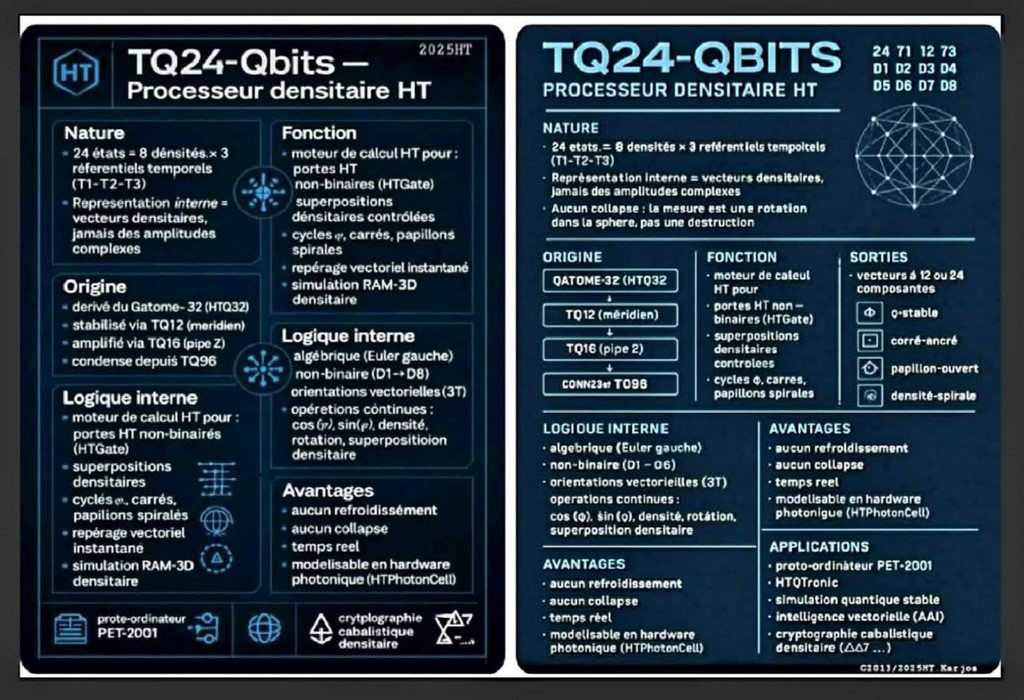
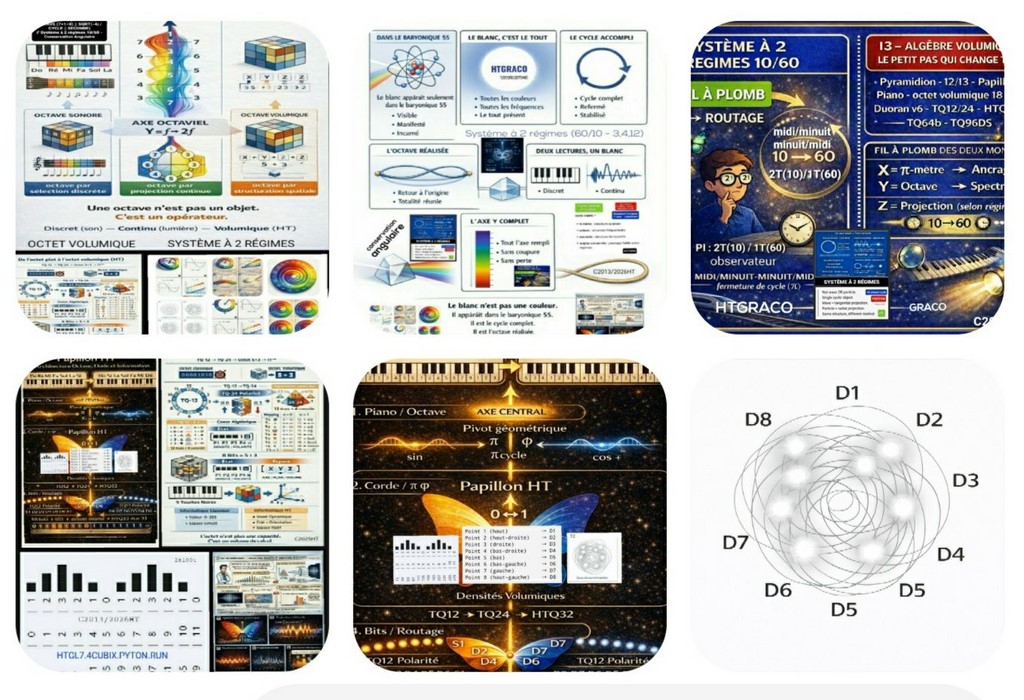

ℹ MORE ABOUT HT
🟩 https://uniq.science
----------------------------------------------------------------------------------------
🟥 EINSTEIN/BOHR
========================
Conflit Einstein / Bohr (EPR)
Constante C de la lumière (1927) C peut être localisée et non localisée. Einstein avait vu juste - Bohr avait vu juste - Les deux avaient raison. :: 👉 https://uniq.science/sqrt.html
🟩 FENTES DE YOUNG
====================
MYSTERY OF YOUNG'S SLITS
DUALITÉ ONDE / PARTICULE
👉 https://uniq.science/young.html
L'expérience des fentes de Young réalisée en 1801 par Thomas Young a prouvé la nature ondulatoire de la lumière en la faisant passer à travers deux fentes étroites très rapprochées. :: Thomas Young's 1801 double-slit experiment proved the wave nature of light by passing light through two closely spaced slits. //
🟦 MATH & ISSUES
https://uniq.science/mathissue.html
🟧 LA GÉOMÉTRIE
https://uniq.science/fibonacci.html
🟦 LLM OUTILS D’OR
https://uniq.science/goldmap.html
Tools : https://uniq.science/htlab.html
🟩 LLM GRACO
https://uniq.science/htgraco.html
🟥🟦🟩 LLM KERNEL
HTQ32 // AMOLF-2013
https://uniq.science/htq32.html
TQ24Qubits Kajoa Core
https://uniq.science/tq24.html
Qunizy AAI 24Qubits
----------------------------------------
⬛ C2013/2026 HT-LAB
🟩 https://www.uniq.science
🟦 HTGRACO — LLM Kernel -